One data model, mapped forward into every disclosure and prudential regime you report against — configured per jurisdiction, not rebuilt, because the underlying regulatory map keeps moving.
Our research team tracks disclosure and prudential regimes region by region — not as a compliance checklist, but as a live input to how the platform is configured. A sample of what that tracking looks like right now:
The EU’s Omnibus I Directive cuts CSRD/ESRS scope by an estimated 80–85%, exempting most previously in-scope companies and trimming the standard from roughly 1,073 to around 320 datapoints. The UK is moving the other way: final UK SRS S1/S2 published February 2026, with FCA consultation CP26/5 proposing mandatory climate disclosure for c.515 listed companies from 1 January 2027.
The SEC’s 2024 climate rule was stayed, its defence withdrawn, and rescission proposed in 2026 — while California’s SB 253/SB 261 has become the country’s most binding instrument via an extraterritorial “doing business in California” test. Canada’s CSDS 1/2 remain voluntary even as OSFI Guideline B-15 imposes binding, NGFS-scenario-based obligations on federally regulated financial institutions.
SEBI’s BRSR Core assurance perimeter scales from the top 150 to the top 1,000 listed companies by FY 2026-27 — one of the fastest-scaling assurance mandates anywhere. In parallel, the Carbon Credit Trading Scheme sets binding, facility-level intensity targets across roughly 740 entities, while the RBI’s prudential climate-risk framework remains in draft.
The UAE’s Federal Climate Law (in force May 2025) sits alongside SCA, ADX and DFM listed-company rules and separate ADGM/DIFC free-zone overlays. Saudi Arabia’s Tadawul guidance remains comply-or-explain; Bahrain and Kuwait have moved to binding mandates; Oman is transitioning from voluntary to mandatory. No single template covers the region.
South Africa’s JSE Sustainability and Climate Change Disclosure Guidance, King IV and the CIPC’s XBRL sustainability module anchor the continent’s most developed regime, backed by Prudential Authority Guidance Note G3/2025 and the SARB Climate Risk Stress Test. Nigeria and Kenya have committed to mandatory IFRS S1/S2 on fixed timetables (2028 and 2027); most other markets remain voluntary.
AASB S2 connects climate risk directly to strategy, decision-making, financial effects and resilience, with scenario analysis proportionate to circumstances. The platform is built around the same principle: the enterprise-level disclosure figure and the asset-level decision figure stay traceable to one another, not just to a filing.
“30% of assets exposed to high physical risk” is a perfectly good line in a filing. It tells a board or a regulator nothing about which 30%, which hazard, or what to do next — and that is a different, harder problem than disclosure.
Can we report our climate risks and emissions?
Can we reliably measure our exposure?
Can we identify and assess material risks and opportunities?
Do we understand where, when and how those risks manifest?
Does climate intelligence shape capital, procurement and strategy?
Can we continuously monitor changing conditions and adjust?
The real organisational advantage begins around stages 4–6 — which is exactly where a spreadsheet-and-consultant stack runs out of road.
The Climate Action Platform is built to hold disclosure and decision information on the same data spine, so both stay traceable to one another.
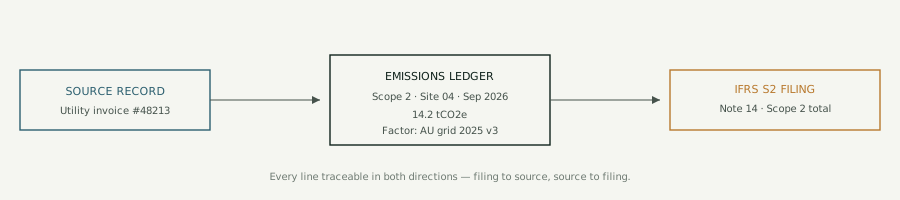
A filed number should lead back to the record it came from — and a source record should show every filing it fed. That is what an assurance provider tests for, and it is how the disclosure agent is built.